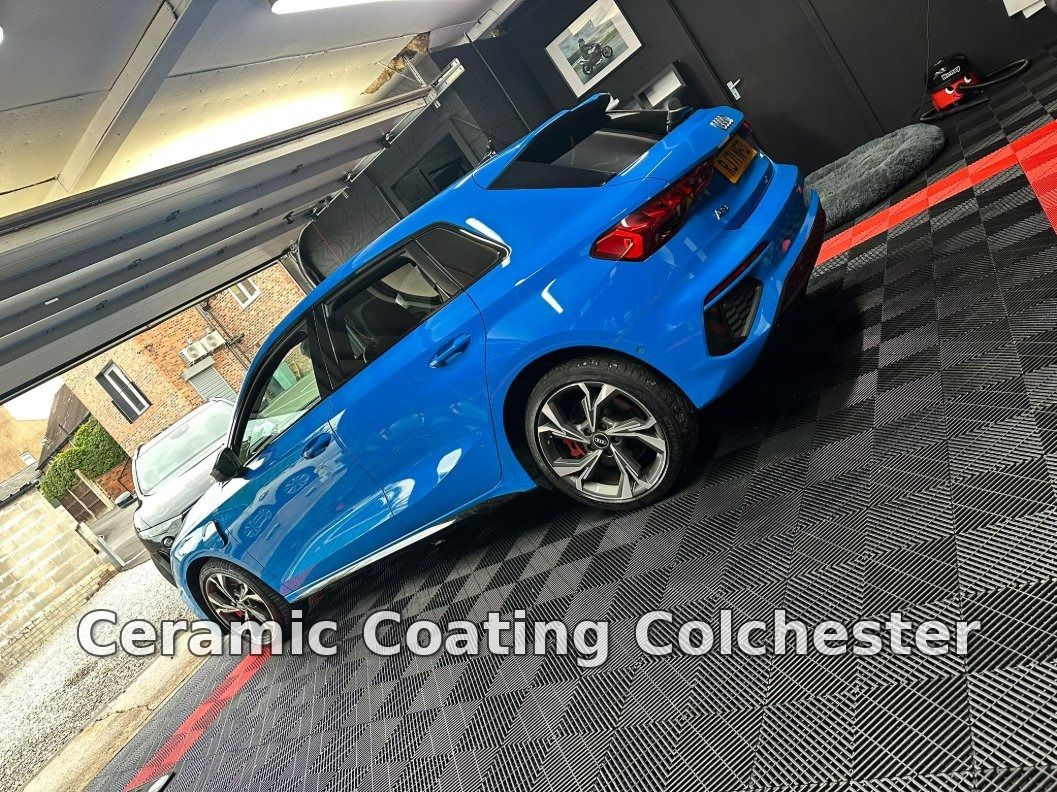
What is ceramic coating?
Ceramic coating is a liquid polymer — usually based on silicon dioxide — applied to paintwork that cures into a hard, transparent, glass-like layer. It deepens gloss, makes washing easier and helps paint resist UV, road salt and chemical staining. It is not scratch-proof, still needs maintenance, and works best on properly prepared paintwork.
For the deeper dive — costs, myths, maintenance — see our ceramic coating guide.
TL;DR
- A liquid that cures into a hard, transparent protective layer bonded to your paint.
- Main benefits: deeper gloss, easier washing, resistance to UV, salt and chemical staining.
- Main limits: not scratch-proof, won't stop stone chips, still needs proper washing.
- Works on all colours; shows most dramatically on dark paint.
- Preparation (decontamination + machine polishing) matters more than the product.
How it bonds to paint — in plain English
Think of your car's clear coat as a surface covered in microscopic pores and imperfections. A ceramic coating is a liquid full of tiny particles that, once spread thinly over properly cleaned paint, begin to link together — chemists call this cross-linking — and harden as the solvents evaporate. The result is a thin, hard, transparent shell chemically bonded to the surface rather than just sitting on top of it.
That bond is the whole point. Wax melts, washes off and needs reapplying because it only rests on the surface. A cured ceramic layer is part of the surface, which is why it lasts so much longer and shrugs off chemicals that would strip wax in one wash.
Two things have to be true for that bond to work: the paint must be surgically clean (hence the wash, chemical decontamination and panel wipe), and the coating needs undisturbed time to cure. Coating over contaminated paint is like painting over dust — it might look fine for a week, then fail.
What ceramic coating does
- Deepens gloss — the hard, level layer reflects light more cleanly than bare clear coat, especially on dark colours.
- Makes washing easier — dirt and road film release more readily from the slick, hydrophobic surface.
- Resists chemical staining — bird droppings, bug splatter, road salt and industrial fallout are less likely to etch into the paint if removed reasonably promptly.
- Adds UV resistance — helps slow the oxidation and fading that sun exposure causes over years.
- Sheds water — strong beading and sheeting that keeps working between washes.
What it honestly doesn't do
- Stop scratches — it adds a small amount of mar resistance, but keys, bushes and grit will still mark paint.
- Stop stone chips — a thin chemical layer cannot absorb impacts; that's paint protection film's job.
- Fix existing damage — it locks in whatever is underneath, swirls included. Correction comes first.
- Eliminate washing — a coated car still gets dirty; it just cleans up faster and more safely.
The three grades of "ceramic" products
| Grade | What it is | Honest expectation |
|---|---|---|
| Spray sealants | "Ceramic" sprays and quick detailers | Easy to apply, short-lived; a good top-up, not a coating job. |
| Consumer coatings | Bottled coatings sold to DIY users | Real bonded layer, but application and prep are on you — results vary widely. |
| Professional coatings | Installer-applied, often with controlled curing | The full job: proper prep, even application, longest durability. |
The marketing rarely distinguishes these clearly. When someone says "ceramic coating", ask which grade they mean — the difference in outcome is enormous. If you're considering the professional grade, take a look at our ceramic coating packages: each one is scoped to the car and quoted in writing.
Ceramic coating and UK conditions
British weather is a decent argument for coating. Road salt from winter gritting, acidic bird droppings, tree sap, hard water spotting in many areas, and the fine abrasive film that builds up on motorways like the A12 — these are exactly the contaminants a chemical-resistant, easy-to-clean layer handles best. Coastal drivers get an extra dose of salt air. None of this makes coating mandatory, but it explains why UK owners who keep their cars tend to rate it highly.
Where did ceramic coating come from?
Ceramic coatings grew out of industrial and aerospace surface technology — the same family of chemistry used to protect everything from industrial equipment to building glass. The car-care versions arrived as the formulations became workable at ambient temperatures and in thin, optically clear layers. Early products were finicky and strictly professional-only; today's market spans everything from enthusiast bottles to highly engineered pro coatings.
That history explains two things. First, why the marketing borrows scientific-sounding language — the chemistry is genuinely sophisticated. Second, why application skill matters so much — these products were designed for trained applicators, and the best results still come from hands that understand the chemistry, not just the sales sheet.
Ceramic vs graphene: an honest note
You'll see "graphene coating" marketed as the next step beyond ceramic. Graphene is a real material with remarkable properties in the lab, and some detailing products do incorporate graphene or graphene oxide. But be sceptical of dramatic claims: in a bottled car-care product, the graphene content is typically minimal, and independent verification of superiority over a good ceramic coating is thin. Our advice is the same as for any product claim — judge it on documented performance (gloss, water behaviour, durability with maintenance), not on the buzzword on the label. A well-applied ceramic from an honest installer beats a hype-driven product applied badly, every time.
Who this isn't for
If you want a product you never think about again, ceramic coating will disappoint you — it needs proper washing to keep working. If your car lives at the automatic car wash, the brushes will degrade the coating faster than you'll see the benefit. And if the paintwork is badly damaged, no coating fixes that; correction or respray comes first.
Questions, answered honestly
Is ceramic coating the same as wax?
What is ceramic coating made of?
Does ceramic coating work on any colour car?
Can ceramic coating be removed?
Is ceramic coating permanent?
Get an exact quote for your car
Now you know what it is — if you'd like it on your car, tell us the make, model and year and we'll quote the right package in writing.
Call 07778 902278 · Request a quote